Tuesday, 13 June 2023

Reining in TER (Total Expense Ratio) Vs. Profitability of Mutual Fund Schemes


Lately, SEBI has issued a Consultation Paper for reviewing TER (Total Expense Ratio) charged by AMCs (Asset Management Companies) to unitholders of schemes of Mutual Funds. The aim is to facilitate greater transparency and accrual of benefits of economies of scale to investors. 


The basic objective of Mutual Funds is to extend the benefits of expertise in investments to common public specifically to those who don't have large capital to invest and who don't have adequate knowledge of the working of financial instruments. These Mutual Funds are usually managed by AMCs  who take the money from the investors by selling Mutual Fund units and invest them in different equity or debt instruments and then hand over the major chunk of profit generated by this to unitholders. As this requires significant application of expertise they charge their fees in form of Expense Ratio over and above Entry Load (now not charged in India), Exit Load and Transaction Charges. 

For saving the usually less aware investors (unitholders) from the whimsical amounts in the name of charges of AMCs, SEBI has put a cap on the Expense Ratio since long. But even in this framework some of the expenses have been kept aloof from this capping clause so far. Such charges are -

i. Brokerage and transaction costs (up to 0.12% for cash and 0.05% for derivatives)

ii. Expenses not exceeding 0.30% of daily net assets subject to net inflows from B-30 cities

iii. Additional expenses not exceeding 0.05% of daily net assets for the schemes having Exit Load

iv. GST and advisory fees 

It is worthy to mention here that there is no upper cap on additional expenses as a whole.

But the Mutual Fund industry has grown significantly over the last few years with considerable increase in participation of retail investors. Hence the concerns existing at the time of introduction of additional expenses over and above the TER may not hold true today keeping in views of economies of scale. Moreover, since there is ambiguity and lack of transparency in the manner in which unitholders are charged by different Mutual Funds. In the view of SEBI, it is desirable that TER reflects the maximum expense ratio that an investor may have to pay and hence it should be inclusive of all the expenses permitted to be charged to an investor and investor should not be charged any amount over and above the prescribed TER limits. And the recent Consultation paper of SEBI has proposed to implement the same.

As in the extant provisions, AMCs are already allowed to become a proprietary trading member for carrying out trades in the debt segment of the recognised stock exchange on behalf of its mutual fund schemes and are also permitted to become a self-clearing member of the recognised clearing corporations to clear and settle trades in the debt segment on behalf of its mutual fund schemes. As SEBI intends to bring the brokerage and transaction cost within the TER limits (and not charged over and above it as of now) there is a likelihood that this may reduce some profit of AMCs for increasing the profit of unitholders. So something must be done to lessen the expenses of AMCs too. This is proposed to be done by allowing them to exercise their option of obtaining limited purpose membership with stock exchanges for carrying out trades in both debt and equity segments. This step will help them to reduce expenses towards brokerage and transaction cost. As this step is a win-win for both AMCs and unitholders so undoubtedly a welcome step.

For promoting inclusiveness of Mutual Fund schemes it is desirable that there should be more incentives to the distributors working in smaller cities namely B-30 cities i.e. cities other than the top 30 cities in India. Though it looks a benign provision which actually serves the motive of addressing the right of equality in financial investment of comparatively interior areas of India, the problem arises when it is misused. Investment amounts higher than INR 2 lakhs (threshold for classification as retail investment) are often split to make each application for investment of less than INR 2 lakh so that B-30 expenses can be charged. Also in many cases, investments of B-30 investors are often churned by way of withdrawal and re-investment after a year (One year is the minimum holding period requirement). Moreover the varying methods of computing additional expenses for inflows from B-30 cities and charging of expenses based on projections rather than actuals add to lot of confusion. So, if the distributors are paid B-30 expenses for investments from only the new individuals (PAN) added as proposed then it must reduce the malpractice of churning by way of withdrawal and re-investment every year just to avail the expense benefit. Also, the proposal of charging of expenses on actuals and not on projected figures is well-appreciated. The additional commission is proposed to be fixed at 1% subject to a maximum of INR 2000/-.

Exit Load is allowed to AMCs in case of early redemption by investors. The intent behind the said amendment was that early redemptions by investors from the scheme has impact on the non-exiting investors and thus they should be compensated by crediting exit load to the scheme. AMCs can presently charge additional 5 bps (basis points) i.e. .05% of daily net assets due to credit of any exit load to the scheme. The said additional charge was allowed for schemes where SIDs (Scheme Information Document) have a provision of charging of exit load. But here SEBI found that AMCs can charge additional 5 bps to the scheme even if there is no claw back/ exit load credited to the scheme. So, it has proposed that this additional expense of 5 bps should be discontinued. Some people say, rather than discontinuing it, this expense should be allowed on the actual amount of exit load charged and credited to the schemes. By this, they think, the purpose of safeguarding the interest of non-exiting investors would be served more accurately.

GST (Goods and Service Tax) on investment and advisory fees is presently charged over and above the specified TER limits which is proposed to be brought under the new TER limit which will be fixed after a suitable adjustment for removing a probable significant impact for change in this provision. Here, it is not clear why the matter is being complicated if SEBI has no objection in allowing GST  on investment and advisory fees over and above the present TER limit.

As per the extant provision, a slab wise TER structure in the MF Regulations has been specified for passing of the benefit of economies of scale achieved by AMCs. It means, higher the AUM size, lesser the limit of TER. The proposal is that TER slabs should be at the level of the AMCs and not at the scheme level. The reason behind this is to avoid switch transactions from existing large AUM schemes to NFO schemes of the same AMC where higher TER can be charged. The bucketing of Equity based AUM and and other than equity based AUM of the AMC is likely to be useful considering the skill set required for analysing and taking decision of investments for equity & equity related products is different from the skill sets required for other than equity related products.

Revision of TER limits is a core proposal of this consultation paper and all the expenses will have to be brought under this TER limit in the new regime. This is vital to revise it adequately so that AMCs should not feel discouraged for applying their best mind and efforts in favour of maximum return to the unitholders. The four additional expenses allowed at present over and above the TER till now will come under the overall limit of revised TER. These expenses are (i) Brokerage and transaction costs which is 0.12% of cash trade and 0.05% of derivative transactions, (ii) Expenses not exceeding 0.30% if daily net assets subject to the inflows from B-30 cities, (iii) Additional expenses not exceeding 0.05% of daily net assets for the schemes having provision of exit load and (iv) GST on investment and advisory fees charged by Mutual Funds/ AMCs.

All of the above expenses will be just a part of overall TER limit after the implementation of new provisions. If the new slabs from 2.5% to 1.3% (for equity oriented instruments) and 1.2% to 0.9% (for other than equity related instruments) had been implemented in FY 2021-22 then the expenses charged had been fallen down from INR 30,806 crores to 29,404 crore lessening the impact by 4.55% at industry level.

Though the weighted average method for hybrid schemes and glide path for AMCs seem to be fine the overall limit of TER may better be fixed after taking the AMCs in confidence since the ultimate return depends on their efficient working and not on regulatory limits on expenses they incur. This is particularly significant in equity oriented schemes.

Other proposal includes disallowance of upfront commission by investor directly to distributors and transaction costs deductible from investments of investors which seems well.

International funds with large AUM have a low cost structure and thus Indian AMCs are often left with less room to charge desired TER for managing investments in such international FOFs. Futher, AMCs are also required to pay licensing fees for using an overseas benchmark. Thus, for avoiding relatively high-cost international funds being sold to Indian investors instead of low cost efficient funds which is not in the best interests of investors it is proposed that the TER shall not exceed higher of two times the weighted average of the TER levied and the actual cost of running a scheme including distribution commission.

To discourage churning / mis-selling by distributors it is proposed that the distributor shall be entitled to lower of the commissions offered under the two schemes of any switch transaction which is fine. The lowering of maximum permissible limit of exit load from 5% to 2% is also proposed. As this will fall under presumably under the overall limit of the new TER any overthinking on it seems futile.

Performance based TER is also being explored and to start with, performance linked TER can be enabled for active open ended equity schemes wherein AMCs can charge higher management fees if the scheme performance is more than an indicative return above the tracking difference adjusted benchmark. Tracking difference adjusted benchmark means benchmark returns adjusted for permissible operational cost of managing the fund. Alternatively, AMC can be permitted to charge higher management fee based on a pre-decided hurdle rate. The maximum management fees may also be specified to discourage fund managers from taking imprudent risk in order to earn higher fees. Though it has been asked by SEBI whether to make performance based TER mandatory or voluntary, the more effective way seems to be making it voluntary. Even though they opt for higher TER based upon their performance the upper cap as mentioned above will save investors from reckless risk-taking propensity.

Additional incentive for inclusion of women investors in Mutual Funds is a welcome step. The grandfathering clause (a provision in which an old rule continues to apply to some existing situations while a new rule will apply to all future cases) seems to be well-intentioned to safeguard the existing investors in ELSS (Equity Linked Saving Schemes), Close Ended schemes and Target Maturity scheme. Yes, it would be just to investors to exit without exit load (as proposed) in case the TER limit is going to increase in their case.

Regular plan and Direct plan are virtually the same after they are bought the only difference being at the time of buying the distribution commission is charged to the investors in case of Regular plan. Therefore, it is but logical that there should be uniformity in charging of each and every expense to the investor of regular plan and direct plan (other than distribution commission).

Putting all the points succinctly it can be said that the proposals mentioned in the consultation paper of SEBI are well-intentioned and seem pragmatic. Though at the same time the ultimate aim should be to ensure enhanced profitability of the working of AMCs by way of tight monitoring and inspection. Needless to mention that even lessening chargeable expenses will have no meaning if AMCs don’t apply their best efforts for ensuring the best returns possible.
….

Author- D Hemant Kumar 
Email- hemantdas2001@gmail.com
Disclaimer: The author is not a Mutual Fund expert and the views expressed in this article is based on his personal understanding and perception over the consultation paper issued by SEBI.

Friday, 12 May 2023

Stocks and Options trading - a first hand experience for the beginners

(Note: The article below is only for education purpose and the author of this article or the administrator of this blog does not take any responsibility of your trade losses on basis of it, if any.)


Advices for Stock trading-


I have been tracking the stock market with a professional mindset since October 2021.  With the help of my Professor brother and his friend Mr. Divyanshu a fair knowledge has been gained and practice of option trading is on which is definitely beneficial. A big banker friend has also taught some effective methods of investment which are also working. In September '21 the market was at peak which was much above normal. After that there were several ups and downs in the index. I also got some shocks but finally I came out successfully. Got to know a lot. The role of luck in the shares trading is not as much as common people think. If you stay with good companies of various sectors for at least one or two years, if you invest significant amount of money but on piecemeal basis after identifying the suitable opportunities and if you keep your emotions under control, then profit is almost certain. Though this all may seem very simple but actually it is difficult to follow the the tenets. The biggest challenge is to control your feelings of excitement or frustration. I am now habituated to this. (17.7.2022)

  ,

Advices for Option trading-

I have been engaged in share/option trading since last fifteen months. I am also helping some relatives and close friends in this matter. Working proficiency in Share trading was got by April 22 and in Option trading by August 22 and now I am successfully moving towards developing it as my profession. Neither I nor any of my relatives/friends had done this work earlier. But now I have gained workable confidence in it. My Professor brother and his friend Mr. Divyanshu Sharma took took this marathon task upon themselves of training me specifically strategic and technical nuances in option trading despite my highly chaotic daily routine and succeeded to a noticeable extent. I express my heartfelt gratitude to these two sensitive scholars, who have received higher education in America.

See, telling in which sector to invest now - it will not be possible for me because my strategy is to keep invested some amount in each of  the sectors all the time.

So far, my conclusion is that trading in stock market requires more of psychological strength than the knowledge of finance because it basically tests your realistic insight and patience. People who do not come under greed, fear or excitement can be more successful in this. They should not be in a hurry to go ahead of others.

Don't jump into option trading without training and practicing mock trading for 4-6 months, otherwise after gaining some profit in the beginning you can make such losses that you can't even imagine. Some free courses are available online which are useful. It is important to understand that options trading is a full-time job, you have to plan in advance to take even a single day off. Option trading is better than stock trading in three respects- (1) It works better and gives you profit even if the market is going down, if the market goes up then you can already earn from your investment. (2) The average percentage of profit in this is often higher as compared to direct share trading. (3) The probability of making profit in this is more as compared to direct share buy-sell and you already have available authentic data regarding probability which is not there in share buying and selling. But the big demerit with it is that it does not work remarkably in low volatility scenario. A VIX level below 15 can be understood as low volatility.

Intraday trading, be it in shares or options, is a very risky business, so be careful and avoid it as much as possible. If you want, you can think of getting professional training from Mr. Divyanshu Sharma who trained me. (21.12.22)
......

Article  by - Hemant Das
Email- hemantdas2001@gmail.com / contact2divyanshu@gmail.com

Tuesday, 1 February 2022

When monkey will come down?

The atmosphere of stock trading is cyclic and seasons come and go like in our real life. But there are some differences. You know well when the winter season will come and end. Likewise, you know about every season like the summer, spring or rainy seasons. In stock trading you don’t know when the spring will come and go. But if you are a seasoned trader you must be knowing as which season traders are in nowadays. And even while you come to know about your trading season with some degree of certainty it is really impossible to predict which day will be normal and which choses to be an aberration for  the declared season. And the patches of aberrations can be so long that you begin to believe that actually the season has changed wholly. The moment you take a move befitting to your assessed season indices you are forced to believe that the declared season has not passed away and is here to stay much longer to an indefinite period.

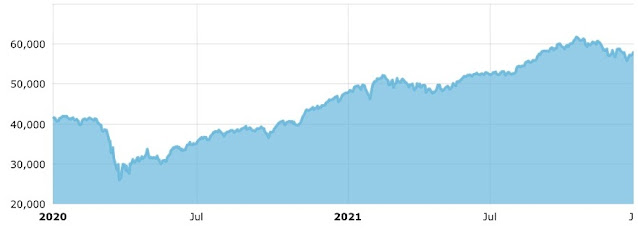
                                 (Graph courtesy- BSE website)

While analysing the sensex graph I had concluded that pre-pandemic level i.e. March 2020 was a sane level of around 41000 which was arrived through reasonable pace of rally. Though the pace of Sensex during 2008-2020 seemed somewhat slothful but it could be said reasonable in view of the almost depression like situation prevailing all around the world. And in March 2020, at the onslaught of Corona, this index took a nosedive to 28000 level which was well expected. Thenafter it was expected to rise gradually to some notches around 40000. But what happened was mesmerising. It went up and up and up for 20 months in a row though of course with some intermittent and insignificant slips. The only logic behind it was the positive sentiment of people that the world will not last in corona and quite a large number of people will survive even after it. And when the vaccination came, the sentiment of the people at large was as if in revelry. Many shops remained closed, many factories stopped production during the covid menace. So the people were left with negligible choices to spend money. More money remained unspent and this led to rise in phenomenal liquidity. This added with the victorious sprit over corona added to the somewhat insane upward movement of the Sensex from 28000 level to 61923 just in 19 months.

Then I thaught that well if it has risen to the Everest level then it must climb down soon and fast. Though I am still confident that it will come down to a reasonable level of around 50000  in line with the annual 10% growth like 40000 to 44000 and then to 48400. See, I have already taken 10% CAGR in place of the usual 6% that is taken for a developing country like India still it is looking like a far cry. The monkey will come down but when only God knows it better.

.......

Author - Hemant K Das

Email - hemantdas2001@gmail.com


Sunday, 21 March 2021

Traversing The Portfolio Theory

 It’s definitely diversity but not a hodgepodge that helps you sail through all the unforeseen tempests.

Diversification across various classes of stocks based on industries, size, value vs. growth etc. within a portfolio helps an investor to minimize risks through summing up different risk behaviours of different stocks while keeping contribution of their respective return unaffected. So an investor has a freedom to construct his portfolio in a manner that risk is minimized and return is maximized.

So early as in 1952 Harry Markowitz changed the whole mindset of all investors who used to measure their success by the performance of each of their stocks separately.  He made it clear that one should not concern if some of the stocks did not show up well over a period of time subject to that it is compensated by the rewards of others. In brief, it is not the individual stock but the whole bunch of different stocks called portfolio that should be under purview.

Markowitz showed in MPT (Modern Portfolio Theory) how an investor can reduce the standard deviation of portfolio return by choosing stocks that do not move exactly together.    

Now, if we draw a graph with Risk (standard deviation of security/portfolio) on X-axis and Return  on Y-axis the efficient portfolio of given stocks would be that which lies upper and left as much as possible.  


See the graph.          

It is really a matter of choice which one of the efficient portfolios is best suited to you depending upon the level of your desire of return and aversion to risk. If you love to play with security market ups and down you are most likely to pick up the portfolio which is expected to go uppermost point with least regard to its dangerous shift towards right direction. Though most of the people like you and me are very conscious about uncertainties in the market and try to minimize risk and stay left considerably. In any case, there is perfectly no point choosing a portfolio given on the graph which lies lower than O as there is always a better return available on the given risk level as the graph shows. 

Expected Portfolio Return is just the weighted average of the Expected Returns of the stocks present in it but Risk (Standard Deviation) has to be calculated by a formula given below.

First we will see how variance is calculated in respect of a portfolio consisting of only two stocks (for the sake of simplicity) and then as we all know that the square root of that will be the standard deviation.

Portfolio Variance =  X12σ12  +  X22σ22  + 2 X1X2 ρ12σ1σ2    

where x1 and, x2  are proportions of stock no.1 and 2, σ1, σ2  are  their standard deviations and  ρ12 is the co-variance between them.


It is to be noted that  The desired portfolio should be only one that lies upper than the critical point ‘O’ and necessarily on the line drawn on the graph which is in fact the maximum return possible on a given level of risk.  

The another important point is that we can achieve any level of return represented by any point on the curve and even more than that by adding the acts of lending or borrowing money at government treasury bill rates that is termed as risk-free investment. And so our investment in part can both be positive or negative depending upon whether we choose to buy a quantity of treasury bill, lend money at treasury bill rate or sell t-bills / borrow money at the same rate. If we lend money or buy treasury bills then our investment in that part is positive and if we sell treasury bills or borrow money at treasury bill rate then our investment in that part is negative and the risk is zero in both of such cases.

The government treasury bills give less interest than the security market but it is almost risk-free and suppose if we expect our present portfolio will give a return of 20% and treasury bills is giving just  10% then some of us may like to take more risk that is associated with security investment. They may think sometimes to sell the treasury bills under their possession for buying more stocks from the market. Though it is always advisable to keep a good mix of treasury bills and stocks all the while.

Suppose portfolio P consisting of a different number of shares of selected stocks is predicted (based on past data) to have an expected return of 20% and a standard deviation of 18%. We have planned to mix some quantity of treasury bills that give an interest of suppose  10% p.a. on zero risk (s.d.).

Now, if we put half of our investment in market securities as in the portfolio mentioned above and half in the treasury bills then 

Return (r) = 1/2 x expected return on P + 1/2 x interest rate  = 15%

Variance = Standard Deviation2 = (σ2) =  X12σ12  +  X22σ22  + 2x1x2  ρ12 σ1 σ2  

                                                                  σ  =  X1σ1 (since  σ2 = 0)

                                                                        = (.5) 18% =  9% 

Now, suppose we borrow money equal to our initial investment at the rate of treasury bill (or sell tresury bills in our possession to such an extent) and invest that amount in our portfolio. Then,

Expected Return, r = 2 x 20% - 1 x 10% = 30%

And, Standard Deviation, σ  =  X1σ1 (since  σ2 = 0)

                                                          = 2 x 18% = 36%

So, if we assume that there is an option   for everyone to lend and borrow to any limit on the rate of treasury bills then the range of investment possibilities can be maximised to a further extent.

In the above graph please see the straight line. Below point M is the case of risk free lending while above M is the case of risk free borrowing. We can see that rightmost curves represent different portfolios of certain combinations of stocks. When they are combined together then we find the curve situated in middle and when we go further by introducing the treasury bills (buy/sell) or lending and borrowing, we find a straight line. The efficient portfolio at the tangent point M is better than all the others. It offers the highest ratio (Sharpe Ratio) of risk premium to standard deviation.

Sharpe Ratio = Risk Premium / Standard Deviation  =  r - rf  /  σ 

William Sharpe, John Lintner alnd Jack Treynor took this discussion to a more simplistic level in mid-60s. in the Capital Asset Pricing Model (CAPM) they said that 

"Expected Risk Premium varies in direct proportion to beta"        
                          r - rf   = b (rm - rf)

where, Risk Premium (r - rf)  is the difference between the investment's expected return and the risk -free rate
and beta is a measure of a stock's volatility in relation to the overall market. 

Now, before we conclude we must take a glance over the important alternative theories propounded in this regard. 

Stephen Ross's Arbitrage Pricing Theory (APT) is altogether on a different footing. It says that each stock's return depends partly on pervasive macroeconomic influences or 'factors' and partly on 'noise' events that are unique to that company. And so,

Return (r) = a + b1 (r factor1) + b2 (rfactor2) b3 (rfactor3) + ......... + noise 

and, Risk Premium (r - rf) =  b1 (r factor1- rf) + b2 (rfactor2- rf) b3 (rfactor3- rf) + .........

Making a more categorical statement Fama and French gave a Three-Factor Model.

r - rf =  bmarket (r market factor) + bsize (rsize factor) bbook to market (rbook -to -market factor) .
                                                                
In a nutshell it can be said that diversification of stocks in security investment helps tremendously in minimising risks though it is still to be found out as what are the actual base of ideology behind that. Though we must be cautious and logical while making investment in security market but there is no reason to hesitate as since 1978-79, the market risk premium (rm - rf) has averaged 9.81% a year in India.

(Author - Hemant K Das)

Friday, 12 March 2021

REIT Vs. Real Estate investment

 A quantitative analysis is the need of the hour


Average daily dollar trading volume of REIT according to a reit(dot)com was $7.2 billion in April 2017, up from $3.7 billion in April 2012 and $2.9 billion in April 2007. Why people in India have taken almost half a century to find an appetite for REIT needs to be analysed. The phenomenon that was a buzz in US since 1960s came to India in 2007 when REIT was introduced by SEBI in India. We took so much of time in concluding that the lesser risk, more safeguards and enhanced liquidity are better than the opposite. To make a comparative study of investments in REIT and direct investment in similar real estate property basket and to come out with some quantitative model is the need of the hour.

Datastream, UBS estimates as on 22.6.2020


In the above Spider graph by Datastream, if all the legs in the graph are speeding out wide means that region is cheaper. Though three of the above graphs are of real estate performance one is particularly about REIT. And you can easily observe that the index of PCF (Price-Cash Flow) is significantly bigger in case of Hongkong's HK REIT than that of Properties.

Investment in REIT has typical edge over direct real estate investments. If a person buys or sell a house property he can’t purchase or sell it in tiny pieces commensurate to his real time requirement but it is possible through investment in REIT shares. You can buy or sell some of your shares whenever you want.  Also, bulk of dividends comes from rental income and not from Capital Gains so that one’s steady flow of income is assured.

India where SEBI (REITs) regulations came in 2014 is not alone in its experience of sluggish start. Even in US the first REIT was set up in as early as 1961 it took several decades for REITs to be accepted as an investment vehicle. Investor familiarity to the vehicle is the main issue behind it. REIT introduced in India by SEBI had to bear a lot of trouble getting off the ground. The country saw its first REIT – Embassy Office Park – in as late as in 2019 after nearly five years and five sets of amendments and multiple tax tweaks.

But if we should take any clue from the only REIT performance  it seems to be on a robust path now. In a Price movement graph published online for a period of 13 Feb’19 to 13 Dec’20 on Dalal Street Investment Journal we can observe that Embassy REIT has mostly stayed significantly upper than S&P BSE Realty index.

Interest income and rental income from property held directly by the trust, is not taxable in the hands of the REIT though Capital Gains would be taxed at the rate of 10% if the units have been held for more than 36 months, which is taxed at 15% in other cases

According to Forbes.com, In 33 years of past, REITs have returned more than 12% annually. This is in comparison to the roughly 10% return of the S&P 500 and the 6% - 8% return of private real estate funds during the same period.

(Author - Hemant K Das)

Tuesday, 9 March 2021

Investments - an analogy to household affairs / Shivam

The other day, while surfing the internet randomly, my eyes caught hold of a quote from Benjamin Graham, the mentor, and teacher of legendary investor, Warren Buffett. Graham says, "the investor's chief problem - and his worst enemy - is likely to be himself. In the end, how your investments behave is much less important than how you behave."  

His words gave me a feeling of clutching at the last straw while drowning. Let me explain. I have been getting several calls from a number of depositors/ investors asking for advice regarding their deposits/investments in a market that appears to have changed due to COVID 19. The callers were people from different professions— right from homemakers to civil servants, technocrats, businessmen, finance professionals, and even seasoned bankers. To my utter surprise, some of my callers were so-called financial advisors, whose very job happens to be advising common people about investments. Even more shocking was their confession that they are not able to muster enough courage to take calls of the investors they used to advise. These people were not laymen but were professionally qualified to offer financial advices and yet, just at the first blow of a crisis were dashed. Anyway that’s not the point I am going to make today. We shall come back to this some other day and here shall focus here on what an investor can do to safeguard their investments.

To reply to the queries mentioned in the preceding paragraph, I was was lookout for something which could be explained to and should be comprehensible to everybody notwithstanding his profession and knowledge level. And finally, I got Benjamin Graham's recipe, "how your investments behave is much less important than how you behave." It may be impracticable to understand minutely how investments behave but everyone can understand and to some extent control how they behave. And this is the issue of discussion today.

The very first thing to be understood is that "my money is my responsibility and that all kinds of sellers, be it bankers; brokers, IFAs or agents have a sense of greater allegiance to their own money and their own organisation. Let us know well the dichotomy between "owning money" and "owning responsibility for money". Understanding this difference, and owning the responsibility (for our money) is the FIRST step towards managing how we behave.

Now, let's ask a question to ourselves - why would a seller or advisor of financial products would toil up for us? The answer, of course, is to earn money. So, when we ask our advisors/ sellers to give us a cut from their commission, we become downright unfair. It makes us a bit like Shylock asking for a "pound of flesh". This might lead to the illegal practice of rebating and its natural outcome is indiscriminate selling and often mis-selling. And this selling or mis-selling is completely devoid of advising elements. If one wants the services of an advisor, one must be ready to pay the fee. The SECOND thing to do is to imbibe in our behaviour the concept/ principle of *'TINSTAAFL' (There is no such thing as a free lunch).* If anyone does provide free services, we must be skeptical and more so, if free service is sugar-coated in the form of freebies. Now, if your advisor has stopped taking your calls or has started avoiding you, it is time to forget him/ her and take charge of your money yourself.

Watching our own behaviour as well as that of our kith and kin can act as a wonderful guide to the 'investor' present in us. Try it! Give your kid something new to eat and watch his skeptic countenance supported with heavy shelling of queries that match exactly to all of those when someone approaches you with a new investment product. The kid sniffs and asks- what is this? Why not A, B or C or one of his favourites? Exactly in the same fashion, give a skeptical look to the seller of financial products and ask, "what's this? Why not those?"  Name a few products even if you don't know much about them and ask how the current product is better suited for you? This kidlike behaviour would be enough to differentiate between an amateur and a professional one. And you can get a sense as the advisor who  withstands your skepticism and inquisitive behaviour while also trying to provide answers to your questions is really a professional buff. This kidlike behaviour is the THIRD behavioral trait* for a successful investor.

Now, grow from kidhood and watch how a homemaker buys grocery items. Have a patience like her. In a vegetables mandi the first thing she does is to take a glance over the whole area consisting of approximately half a square kilometre to get an inkling of the general availability of items and their general price level. Then a suitable shop is chosen that susits to her taste and confidence level. Then starts the real deal. Each piece of potato, onion, tomato etcetera.. etcetera is inspected carefully from all sides, is pressed to measure its ripening stage; sniffed if required. If it passes through all the above quality testing, the bargain begins and the deal is struck at the most competitive price. Once back home, you can hear her say that she could have gotten a better deal, only if she had tried more shops or bargained more. Even after all these precautions if something appears to be inferior, she immediately rushes to exchange or return as the case may be. I often wonder if  Warren Buffett discovered the golden rule of investing while in a grocery shop with Mrs. Buffett, which he later paraphrased as "investors should evaluate stocks not as if they were buying perfume but as if they were buying vegetables". This explains the FOURTH behavioral trait of an investor—  hunt for a good bargain.

Demonetization unearthed a considerable amount of currency notes in denominations of ₹500 & ₹1000 from thither to unknown pockets of homemakers. Maintaining such an unknown pocket is the FIFTH behavioral trait of an investor. One should keep adequate provisions in liquid form for unforeseen events before allocating an amount for investment. Investing without ensuring adequate liquidity for any unforeseen need may put the investor in a precarious situation and subsequently lead to an abnormal loss.  Occasionally,  unplanned investments result in speculative but intoxicating gains that eventually lead to more loss than one could bear easily. Both, initial gain and initial loss in investment, flip our gambling instincts, and can destroy our financial well being. Be careful of both and don't get carried away by either of them. That's the 6th behavioral trait of an investor—practice restraint, especially in the face of initial loss or gain.

It is often said that investment is a long term affair but there is hardly any clarity over what is the ideal duration of the long term? I too have been trying to get an answer to this question. For quite some time, I have been groping around different finance and investment books to find the definition of 'long term' but couldn't find any except that the duology of 'long term' and 'short term' in the context of taxation. Finally, I was able to find some guidance in Warren Buffet's wisdom, whose favourite holding period is forever.  Warren's investment strategy reminds me of an incident from my childhood. Once, while coming back from mandi, my grandfather brought a mango sapling and asked me to come to the orchard. I happily followed him. Then started the process of sowing the sapling. As the chores moved  ahead so did my numerous queries - how long would it take? how many mangoes will grow? how sweet would they be?. I did not remember what my grandfather answered. The answer was none of my concern. Every morning I would go to see the sapling and come back disappointed that there were no mangoes. My grandfather noticed my impatience and on one fine day he explained to me that there was no magic! It would take a minimum of four to five years before I would be able to taste the fruits. Till then I needed to take adequate care, like watering the plant, saving it from animals etc. He also said, if properly nurtured this mango tree would become a lifetime asset and will even benefit future generations. I don't remember how well I understood the message then, but today while trying to understand the long term, my grandfather’s long-forgotten words seem to be more relevant.

My grandfather’s perspective on investment is diametrically opposite to how we behave as investors. More often than not, we start expecting returns from the very next day of investment. Till all of us find someone like the grandfather who appreciates our impatience and explains to us the concepts of investment, let's take a cue from Warren Buffett's 'favorite holding period' i.e. 'forever'. This explains the SEVENTH behavioral trait of an investor— be patient with returns and ready to invest forever.

If we understand and can control these seven behaviour traits, then we can take care of what Benjamin Graham describes as the more important requirement of investor success - how you behave? We will reserve some other day for discussing how your investments behave - the less important requirement in Graham's prescription.
...........
(Author - Shivam, MBA, FMS Delhli) 
The author is a Sr. VP at SBI Mutual Fund, Corporate Office, Mumbai. Respond to him at shivam.kumar@sbimf.com . You may also send your feedback to the editor at hemantdas2001@gmail.com


Thursday, 4 March 2021

Fencing against Cryptocurrency

Stability of the financial sector can be potentially threatened if the private parties are allowed to toy with currencies – this is the view of RBI as well as the Central Govt as per the report published in FE on Mar 4, 2021. Let us look into the nature and working of private cryptocurrencies that have alerted government to such an extent that it thinks to introduce a bill against them.

The source code of cryptocurrencies specifies how many units can ever exist and this limitation feature makes it more and more valuable with every addition in the currency. So it has an in-built deflationary tendency vis-à-vis the government administered currencies of the world that are typically inflationary.

Bitcoin introduced in 2009 by Satoshi Nakamoto (a pseudonym) is the most popular cryptocurrency with a cap of maximum number being 21 million coins. He was also the first person to mine a block. Once miners (computer-tech persons) are able to complete the verification of 1 MB (megabyte) worth of bitcoin transactions they are treated as have mined a block and rewarded with a certain number of bitcoins as fixed by the cryptocurrency’s internal regulation. The miners on their success also get fees that are pre-loaded by buyers of the transactions so that their work of verification could be done on priority basis. A miner is allowed to prioritize fee-loaded transactions over the others. A blockchain is the record of all such transactions in bitcoins from beginning of it till date.

Bitcoin, Litecoin, Ethereum, Ripple are some of the popular cryptocurrencies worldwide whereas in India Bitbns, CoinSwitch, CoinDCX, BuyUCoin, Zebpay are often heard ones.

Cryptocurrencies appear to have come in existence as an informal means of money exchange or might be a product of gaming activity which because of its high level of digital security mechanism and perhaps having been able to keep itself immune to all kinds of government regulations by virtue of their untraceability gained momentum in a short span of time.

The demerit with these currencies is that they can’t be restored if one forgets the private key or codes of their coins. Black marketing is also possible through them. The fact that from origin to the end the cryptocurrencies are able to avoid regulation and taxation have made the governments alert in many counties. Their rapid spread and usage can be a threat to a country’s monetary system and so fencing measures are on.

(Author – Hemant K Das)

Disclaimer: The views expressed are personal and this article is written and published only for academic purpose. The readers are advised to follow all government rules and regulations before thinking for any transactions.

शेयर बाजार जिज्ञासा : क्रम सं. 2 (स्टॉक ट्रेडिंग और आप्शन ट्रेडिंग से सम्बंधित कुछ सवाल-जवाब)/ Hemant Das, MBA

 (Disclaimer (अस्वीकरण): नीचे दी गई जानकारी सिर्फ शैक्षणिक उद्देश्य के लिए है. इस आधार पर किए गए किसी कार्य हेतु यह ब्लॉग या इस सामग्री का ल...